NDA Template + 5 Mistakes That Can Cost You Your Idea
Before you share your idea, read this.
Most people think having an NDA is enough.
It’s not.
The real risk isn’t not having an NDA.
It’s using the wrong one, or worse, using one you don’t fully understand.
And that mistake can quietly cost you your idea, your leverage, or your protection.
The problem nobody talks about
Let’s say you’re:
- pitching a startup idea
- hiring a freelancer
- working with a client or partner
- sharing sensitive business information
You grab an NDA template online, fill in a few blanks, and send it.
Feels safe, right?
But here’s the issue:
Most NDAs fail in practice because of small mistakes that people don’t notice.
Not legal theory. Real-world usage.
Things like:
- choosing the wrong type of NDA
- leaving the purpose too vague
- missing key protections
- signing without reviewing properly
Even something as simple as incorrect party details can make an agreement harder to enforce.
And here’s the part most people miss:
You usually don’t find out your NDA is broken until it’s already too late.
The 5 biggest NDA mistakes (that can actually hurt you)
1. Using the wrong type of NDA
There are two main types:
- Mutual: both sides share information
- Unilateral: only one side shares
If you pick the wrong one, you can accidentally:
- take on obligations you didn’t intend
- leave your own information unprotected
This is one of the most common and overlooked risks.
(Most free templates don’t even explain this clearly, they just give you a file and leave you guessing.)
2. Defining “confidential information” poorly
If something isn’t clearly covered, it may not be protected.
That includes:
- business ideas
- financial data
- client lists
- code or creative work
A weak definition creates loopholes. A strong one closes them.
In fact, the definition section is one of the most critical parts of an NDA because it determines what is actually protected
3. Leaving the purpose too broad
Every NDA should clearly define why information is being shared.
If the purpose is vague, the other party may:
- use your information in ways you didn’t expect
- argue they were allowed to use it
That single section can determine whether your NDA actually works.
4. Missing critical clauses
An NDA isn’t just “don’t share this.”
It should also cover:
- how the information can be used
- who can access it
- what happens after the relationship ends
- who owns the information
For example, without a return or destruction clause, your data might be kept indefinitely
5. Signing without understanding it
This is the biggest one.
Most people:
- skim the document
- assume it’s “standard”
- sign anyway
But NDAs vary more than you think.
And if you don’t understand what each clause does, you’re guessing.
Here’s the real issue
The problem isn’t that you don’t have an NDA.
The problem is:
You don’t fully understand the one you’re using.
And that’s exactly where most people lose protection.
What actually works instead
Instead of just grabbing a template, you need:
- a clear understanding of what each clause does
- guidance on when to use an NDA and when not to
- the ability to customize it for your situation
- a way to review it before signing
Because an NDA is only effective before information is shared, not after
A simpler way to do this (without overcomplicating it)
This is exactly why I put together a complete NDA bundle.
Not just a template you download and hope for the best.
But a system designed to remove the uncertainty.
Explore the NDA Template Bundle here.
Inside, you’ll find:
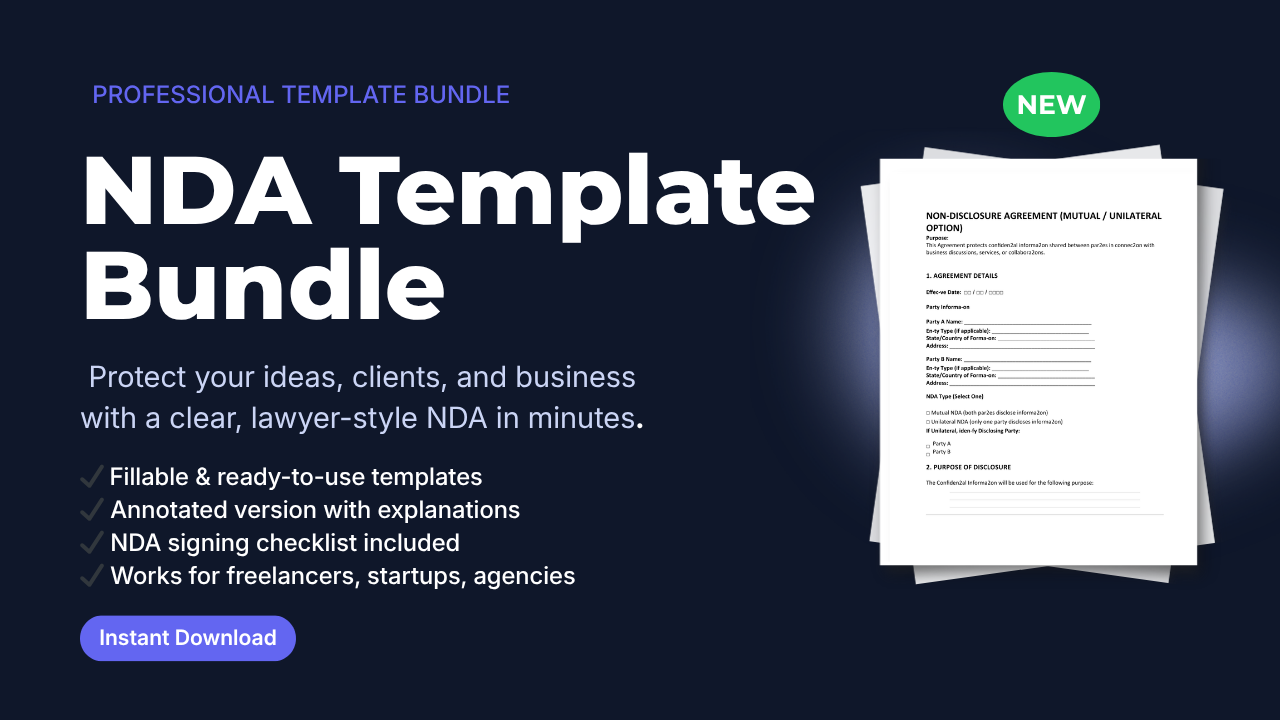
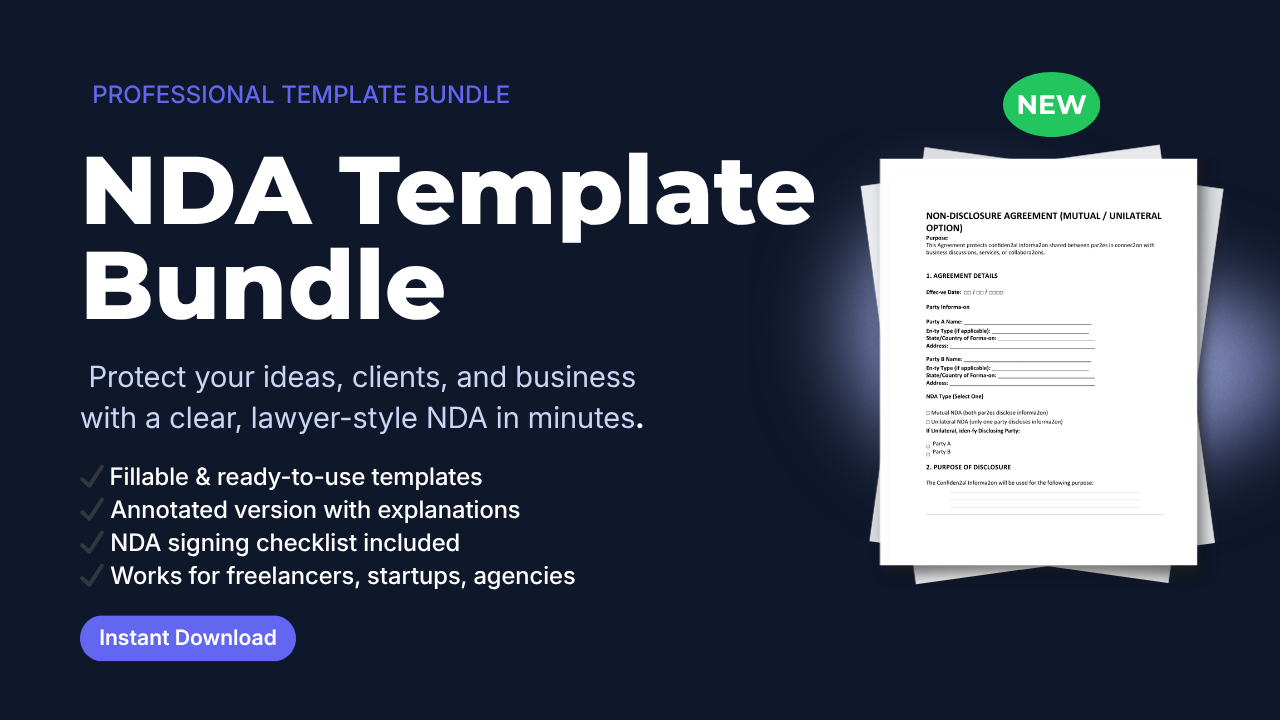
- A clean, professional NDA template (mutual + unilateral options)
- A fillable version so you can actually use it quickly
- An annotated version that explains every clause in plain English
- A step-by-step customization guide for different situations
- A practical “when to use this NDA” guide
- A checklist to review everything before signing
It’s structured so you don’t just have an NDA, you actually understand it and use it correctly
What makes this different (and why people overlook it)
Most people don’t need a “better template.”
They need:
- clarity
- context
- and a way to avoid silent mistakes
For example, a simple checklist alone can catch issues like:
- incorrect party details
- vague purpose statements
- missing protections
before you sign anything
That’s the difference between:
“this looks fine”
and
“this actually protects me”
If you’ve ever felt unsure about an NDA, this matters
Because the risk isn’t obvious.
You won’t know something is wrong until:
- your idea is used
- your data is shared
- or your agreement doesn’t hold up the way you expected
And at that point, it’s too late.
Final thought
An NDA isn’t just a document.
It’s a decision point.
And the difference between:
- feeling protected
- and actually being protected
comes down to whether you truly understand what you’re using.
Want to avoid these mistakes?
If you want a simple, clear way to handle NDAs without guessing:
It will show you exactly:
- what to use
- when to use it
- and how to use it correctly
So you can share your work with confidence, not uncertainty.